
JUNO the bakery, packed for travel
An Østerbro bakery with a daily queue now ships. On Danish Butter Cookies by JUNO the bakery, the white box behind them and a Framer-built shop that feels like the room on Århusgade.
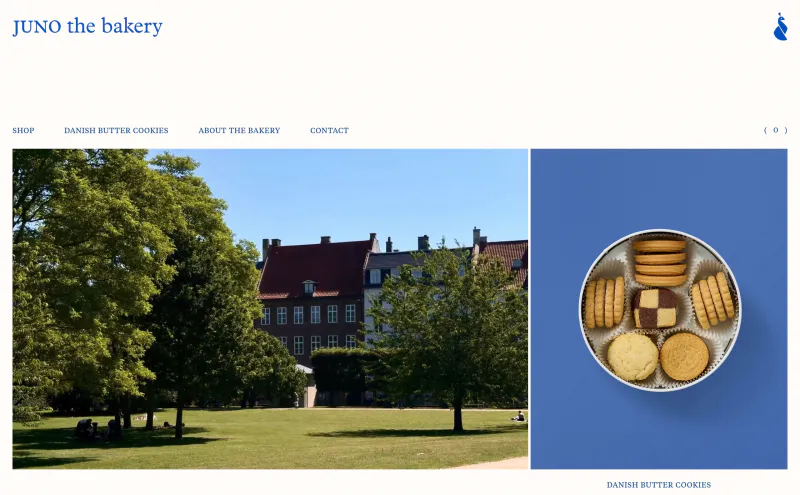
Since 2018 there has been a morning queue on Århusgade, in a quiet corner of Copenhagen’s Østerbro. JUNO the bakery, founded by Nina Schmiegelow and Emil Glaser, has never needed to explain itself to the people standing in it. The harder problem was everyone else: the visitors who leave with a paper bag of cardamom buns and nothing that will survive the flight home.
Danish Butter Cookies by JUNO the bakery is the answer, and it arrives with a new online shop. “For years, we wanted to make something that could travel, survive a suitcase and still taste like JUNO on the other side of the world,” Glaser told The Brand Identity. Then, more simply: “For years, guests have asked us if we ship.”
A souvenir, made properly
Butter cookies are already the thing people bring home from Denmark, often in a blue tin bought at the airport. JUNO’s version is handmade at the bakery’s own facility in Nordvest, Copenhagen, and the shop lists a short range: classic, cardamom, vanilla, rose, oat, vanilla and chocolate, and a Classic selection that gathers several of them in one round tin. Single flavours start at DKK 90; the 225 g selection is DKK 185.
The packaging takes its cue from the bakery itself. JUNO’s white paper bag, chosen, in the words of Kontrapunkt’s creative director Laurits Hanak, “for its instant recognisability in a competitive landscape defined by brown kraft paper”, became the canvas for the whole brand. The cookie boxes stay white, with a blue peacock borrowed from the Roman goddess Juno, Plantin for type and small two-colour drawings of the cookies inside in place of photographs.
The goal was that you should almost smell the cardamom before you add anything to your cart.
CKCarl Kronika, COPUS
A shop that behaves like a bakery
The shop was designed and built by COPUS, the Copenhagen and New York brand agency, with web designer and developer Tommy Campbell. They drew it in Figma and built it in Framer, using Framer Commerce with a Shopify integration underneath. JUNO’s brief was “a digital home that feels like stepping into the bakery in Copenhagen”, and the result is calm in the way good bakeries are calm: a lot of white space, serif type doing most of the work, and JUNO blue saved for the product tiles and the add-to-cart button.
Short films open the page and sit between the products, including one of the morning queue, filmed without staging. Photographs by Fritz Buziek were taken at the bakery, at the production facility and around the neighbourhood. For now the shop sells the cookies, a gift card and the JUNO the bakery book, and ships across Europe.
- 01
JUNO the bakery
Framer and Shopify, used with restraint. Closer to a small magazine than a webshop, and very good at making you hungry.
Who made what
The credits deserve a note, because the cookies have a longer design history than this launch suggests. Kontrapunkt created JUNO’s identity in 2020, and The Brand Identity now credits the agency with the identity of the Danish Butter Cookies line as well. A year earlier, in 2025, the Copenhagen studio Studio Morfar published its own JUNO project, covering illustration, animation and tin packaging for the same cookies, with scenes of Denmark that end at the bakery’s corner, along with an e-commerce site. A vanilla tin in the new shop still comes in an illustrated sleeve in that style. The new shop itself is COPUS’s work.
What makes the launch worth noticing is how little it tries. There is no flagship, no subscription box and no limited drop: just a bakery that already had a queue, giving the people who cannot join it a reasonably good way to take part. Order a tin and open it at home. It is the least Copenhagen-specific thing JUNO has ever made, and probably the most Copenhagen thing you can have delivered.